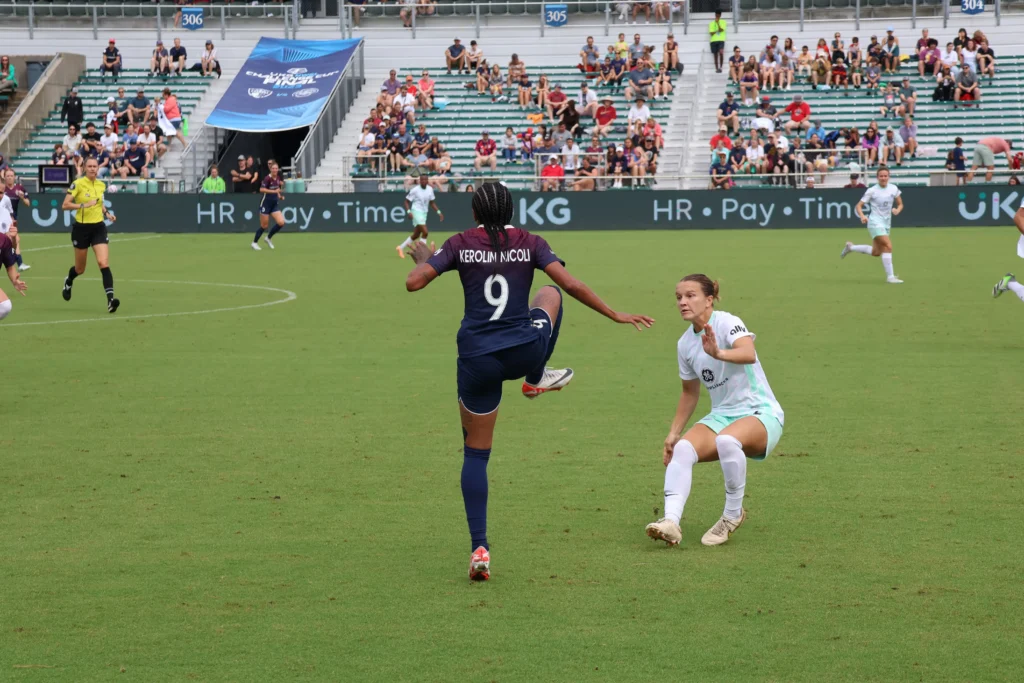
 NWSL
NWSL Just a few years ago, it seemed that the NWSL, the National Women’s Soccer League in the United States, had caught a tailwind strong enough to last for years. Attendance records were being broken, media coverage was booming, and after the U.S. women’s national team’s World Cup triumph, a genuine sense of euphoria swept across the country. Stadiums were packed, and women’s soccer was no longer just a curiosity, it had become a cultural phenomenon.
Today, though, questions are being asked that would have sounded absurd back in 2022: is interest in the NWSL beginning to fade?
The numbers are concerning. Average attendance in the 2024 season fell by more than ten percent compared to the record-breaking 2023, and the projections for 2025 aren’t looking much better. In some clubs, particularly those outside major media markets, stands are half-empty. The crowds that once created a carnival-like atmosphere have thinned out, leaving behind clusters of loyal fans trying to keep the spirit alive.
The Post-Pandemic Hangover
The boom in women’s soccer was unique, but also, as we now see, fragile. After the pandemic, people craved shared experiences: concerts, games, the emotion of being in a crowd. The NWSL hit that moment perfectly. Every match was more than a sporting event; it was a symbol of renewal, and at the same time, a statement of equality and modernity. Fans came not only for the soccer but for the idea behind it.
But emotional highs don’t last forever. Fatigue, inflation, rising ticket prices, and competition from other forms of entertainment have all taken their toll. By 2024, America had returned to everyday life, and attendance began to reflect genuine engagement, not temporary enthusiasm. The post-pandemic surge is now a memory, and what remains is the question: can the NWSL build a lasting bond with its audience?
The Magic of Success Has Worn Off
There’s no denying that for years the NWSL rode the wave of the U.S. women’s national team’s success. Megan Rapinoe, Alex Morgan, Rose Lavelle, those names carried the league. Every appearance by a superstar was an event in itself, and clubs basked in the reflected glow of the national team.
But now Rapinoe is retired, Morgan is nearing the end of her career, and the younger generation hasn’t yet captured the same media magnetism.
Without those household names, the league suddenly looks more “ordinary.” And that’s not necessarily a good thing. Because the fans who once came to see their heroes now have to connect with the teams themselves, their playing styles, their local identities. That’s a slow process, one that demands investment in storytelling, marketing, and authentic community ties.
Women’s Soccer in the Shadow of the Algorithm
Another factor: digital visibility. Back in 2020 or 2021, social media feeds were full of spectacular goals and moments of empowerment. Today, algorithms are far less generous. Platforms now favor short, sensational, disposable content, not the slow burn of building a narrative. Women’s soccer, for all its passion, can’t easily compete with viral dances, reality shows, or influencer culture.
On YouTube, TikTok, and Instagram, NWSL clips simply don’t reach the same numbers they once did. And if you’re invisible online, for much of the younger audience, you don’t exist at all.
Podcasters dissecting the attendance drop often point out that the problem isn’t just in stadiums, but in the attention ecosystem. In a world where every minute of user focus is up for grabs, women’s soccer must fight for its place in the collective consciousness, and that’s a tougher battle than any on the field.
Has the NWSL Become Too “Normal”?
Paradoxically, the very professionalism that was supposed to strengthen the NWSL may have dulled its edge. Sleek new stadiums, corporate sponsors, polished broadcasts, higher salaries, all of it has brought the league closer to the standards of the men’s game. But in doing so, it may have lost a bit of its original magic, the rebellious spark of the underdog fighting for recognition.
Once, going to a women’s soccer match was a kind of statement: I’m here because I support women in sports. Today, it’s just another weekend entertainment option. And entertainment, by nature, is replaceable. A movie, a streaming binge, baseball, the NBA, even e-sports, they’re all competing for the same few free hours.
The Economics of Emotion
Many experts argue that the NWSL still hasn’t found the right balance between sport and social mission. The league wants to be both a stage for ideals and a viable business, and that’s a tough combination.
On one hand, the NWSL’s story is one of determination, equality, and empowerment. On the other, it’s a commercial product that must make money. When the inspiration fades and the financial realities kick in, many clubs are left with empty seats, and even emptier budgets.
As one executive put it bluntly: “The NWSL doesn’t just need fans, it needs customers.” The problem is that those two roles rarely overlap. A fan loves. A customer calculates.
A New Model of Engagement
Does this mean the future of women’s soccer in the U.S. is in danger? Not necessarily. This might actually be the moment of growing up. After all, no league can live forever in a state of euphoria. After the high comes the phase of building foundations: loyalty programs, local partnerships, youth academies, family-friendly matchdays.
That might be the key, not chasing fleeting hype, but nurturing the next generation of fans. The kids who go to matches with their parents today could be season ticket holders in a few years. But only if the NWSL stops being a passing trend and becomes part of everyday life.
Numbers Don’t Lie
According to analysis by WomenLiveScore, average attendance in 2024 was around 8,500 spectators per game, roughly 15% lower than the previous year. Seattle saw a 12% drop, Kansas City as much as 20%. Only Portland Thorns and San Diego Wave managed to maintain near-record levels.
The downward trend could continue into 2025, though not everywhere. Clubs that invest heavily in community relations and fan engagement, like Portland or North Carolina Courage, remain relatively stable. That suggests the decline isn’t a death sentence, but a warning.
“What Would Make You Come Back to an NWSL Game?”
That question pops up more and more often on social media. And there’s no easy answer. Every fan has their own motivation: some come for the quality of play, others for the emotion, still others for the sense of belonging.
Maybe the league simply needs a new communication strategy. Less slogan-driven “girl power,” more stories about passion, tactics, and rivalry. Women’s soccer doesn’t need to be framed through ideology, it