
 Primera Division Women
 Spain’s Liga F has found itself in a situation that until recently seemed difficult to imagine. A competition featuring FC Barcelona and Real Madrid, in a country belonging to the global elite of women’s football, has a serious problem selling its television rights. And this is a problem that cannot be reduced solely to a discussion about promotion or insufficient media interest.
DAZN, the league’s previous broadcasting partner, has decided not to continue the cooperation under the existing terms. The broadcaster was paying around €7 million per year, but from a business perspective, the investment reportedly failed to deliver the expected results. In subsequent negotiations, the value of the offer fell—first to around €5 million, then to €2 million.
Despite the significant reduction in expectations, finding a buyer has proved difficult. This is a signal that the competition’s authorities should not ignore.
Sporting Success Does Not Guarantee Commercial Success
The case of Spain is particularly interesting. It is difficult to argue that women’s football there lacks recognizable brands, success or stars.
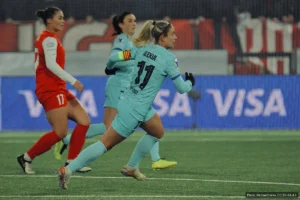
FC Barcelona Femení has become one of the most successful and recognizable women’s teams in Europe. Real Madrid gives the league a brand with global reach, while the Spanish national team has been among the absolute world elite in recent years.
In theory, therefore, almost all the elements needed to create an attractive media product are there. The problem is that success on the pitch and interest in the biggest matches do not automatically translate into the economic value of an entire competition.
A broadcaster buying league rights is not paying only for El Clásico or the most important matches of the season. It is buying the entire package. It must cover the costs of production, broadcasting, promotion and editorial operations, and then recover that money through subscriptions, advertising or other sources of revenue.
If the numbers do not add up, the popularity of a handful of major matches may not be enough.
The Market Is Asking Questions That Cannot Be Avoided
Over the past decade, the development of women’s football has been one of the most important trends in European sport. Investment by clubs has increased, as have the number of broadcasts, sponsor interest and attendance at the biggest events.
At the same time, it has often been assumed that greater exposure would almost automatically lead to an increase in the commercial value of competitions.
The case of Liga F shows that the relationship is not that simple.
For a broadcaster, the numbers remain crucial: how many viewers regularly watch the matches, how many new customers can be acquired through them, how much time they spend watching broadcasts and what value they represent to advertisers. It is also important whether interest extends across the entire competition or is concentrated primarily around a few of the biggest clubs.
This is not something unique to women’s football. Rights to every sport are valued in a similar way. The media market can support the development of a product, but ultimately it expects the possibility of generating a return on investment.
The Problem May Be the Structure of the Entire Product
The current situation should encourage Liga F’s authorities to conduct a broader analysis rather than simply search for another broadcaster.
The questions concern more than just the price of television rights. Attendance, the competitiveness of the league, the attractiveness of matches between teams outside the very top, the way local fan communities are built and clubs’ ability to turn occasional interest into regular sports consumption are all important.
This is one of the biggest differences between an event and a league product.
The final of a major tournament can attract an audience of millions. A match at a major stadium can set an attendance record. Such events have enormous marketing value, but the business of a league is built primarily during an ordinary weekend of the season when viewers have to be persuaded to watch a mid table match.
If that interest is missing, the value of the entire rights package remains limited.
Neither a Disaster Nor Something That Can Be Ignored
Problems selling television rights do not mean that women’s football is destined for commercial failure. That would be just as premature a conclusion as the earlier belief that rapid growth in interest would automatically guarantee profitability.
The women’s sports market continues to develop, but individual leagues are at different stages of building their value. Not every investment has to generate an immediate return. In professional sport, investing in a project at a loss for several years is not unusual if investors see a realistic prospect of future revenue.
The key word, however, is “prospect.”
If successive parties are unwilling to pay the price that the rights holder considers justified, it becomes necessary to ask not only how much more money needs to be invested, but also what exactly is supposed to make the product worth more in a few years’ time.
This is where the discussion about Liga F should move beyond the two most commonly repeated positions: on one side, the belief that every difficulty is the result of insufficient support for women’s sport; on the other, the claim that every financial problem is proof that these competitions have no future.
Both approaches are too simplistic.
The Most Important Test Is Still Ahead
Spanish women’s football has reached a sporting level that would have been difficult to imagine just a dozen or so years ago. It now faces a far less spectacular, but perhaps more important, challenge: it must prove its value as a regular media product.
Record breaking matches, promotional campaigns and declarations about the sport’s potential will not do that. Regular audiences, growing revenues, fuller stadiums, greater competitiveness and fans willing to pay to watch the competition will.
The story of Liga F’s television rights is therefore about more than a dispute over a few million euros. It is a test of the maturity of women’s football’s business model.