
 NWSL
NWSL The women’s football market is undergoing a rapid transformation. The dynamic growth of European leagues, especially the English Women’s Super League, means that the best players from the United States now face a real dilemma: stay in the National Women’s Soccer League (NWSL) or take advantage of the rising financial and sporting opportunities in Europe. The case of Trinity Rodman, one of the biggest stars of American soccer, perfectly illustrates how the NWSL’s strict salary-cap rules can influence career decisions for top players.
NWSL vs. European Money – What the Financial Reality Looks Like
For years, the NWSL has built its league around stability and competitive balance. At the core of this model is a strict salary cap, which for the 2025 season stands at around USD 3.3 million per team, with only minor increases allowed through revenue-sharing mechanisms. In theory, the system is meant to protect the league from uncontrolled spending and ensure competitive equality. In practice, however, it has also become a limitation that makes retaining top players more difficult.
Every player’s salary, including bonuses and commissions, counts toward the team cap. A club can exempt only four contracts from the cap, and even then, the exemptions come with numerous restrictions. With a typical roster of about 24 players, it becomes nearly impossible to offer a multimillion-dollar contract to a single star without disrupting the team’s entire financial structure.
Meanwhile, in Europe, especially in England, Spain, and France, salary caps are more flexible or even nonexistent. The biggest clubs benefit from the financial power of their men’s teams and strong commercial revenues, which significantly boost their spending capabilities. As a result, offers from Europe are often far more attractive in terms of both salary and additional benefits.
Trinity Rodman and the Wave of Interest From Europe
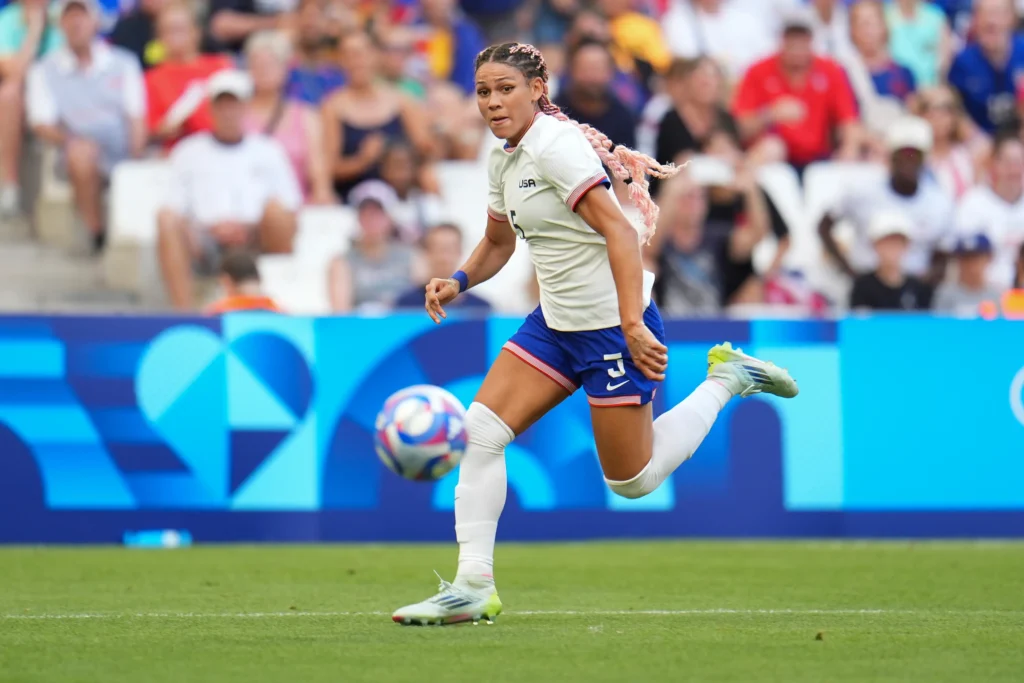
Trinity Rodman is a perfect example of the challenge facing the NWSL today. Her contract is nearing its end, and the Washington Spirit have been trying for months to find a way to keep their biggest star. But under the current salary-cap rules, the club’s options are simply limited.
Rodman has not hidden the fact that the prospect of playing in Europe is appealing to her. Clubs in the Women’s Super League, including Chelsea and Arsenal, have not only the financial means but also offer Champions League competition and global exposure, which is now a key part of a player’s marketing value.
The NWSL insists that it is fighting to keep its top names, but the financial realities are clear: this may become increasingly difficult. As European clubs send an ever-stronger message,“we can offer more”,players are beginning to view the market globally, not locally.
Consequences for the League and the Future of the System
Losing players of this caliber is not just a sporting blow. It also weakens the NWSL’s brand, reduces media attention, and diminishes the league’s star power, one of its key tools for attracting fans. Commissioner Jessica Berman emphasizes that the salary cap creates parity within the league, but she also admits that the system will need modernization if the NWSL wants to compete in the global market.
Pressure is already mounting, from both players and clubs, to gradually increase salary flexibility, especially for world-class stars. The question is whether the league will introduce significant reforms before the departure of top names becomes a trend rather than an exception.
European clubs are increasingly bold in pursuing American talent, and Trinity Rodman is one of the most prominent examples of this offensive. The NWSL’s current financial model, although stable and well-designed, may prove too conservative in a global industry entering a phase of rapid investment growth.
If the league wants to maintain its status as the best and most exciting in the world, it will have to answer one crucial question: can it afford to keep its own stars? Because Europe has already shown that if it cannot,the door is wide open.