
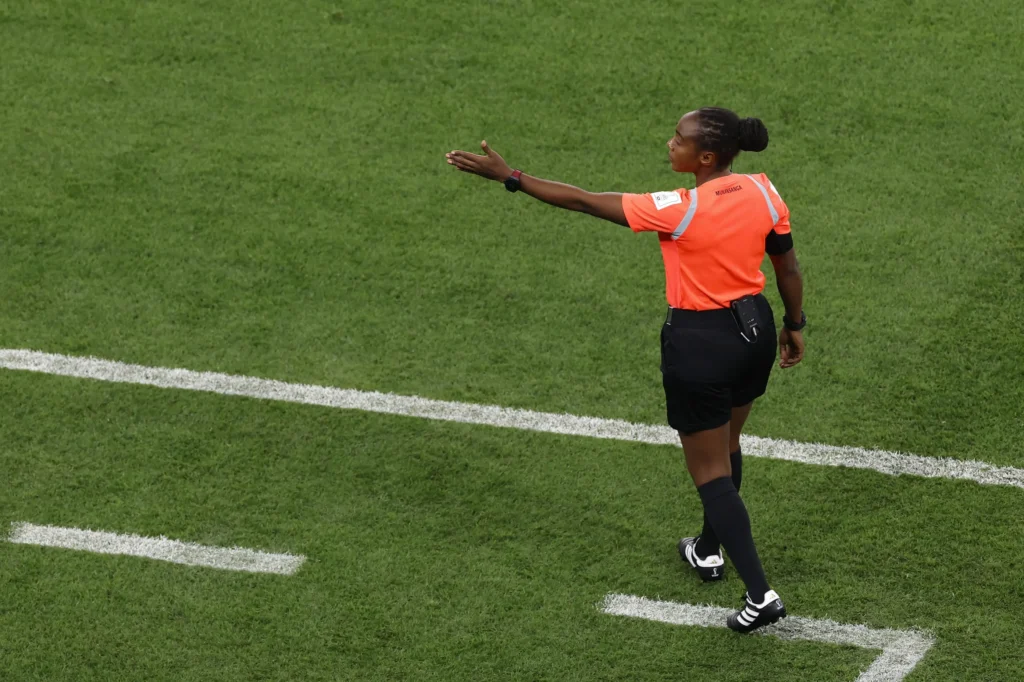
When FIFA announced the list of referees for the 2022 World Cup in Qatar, the football world held its breath. Among the men, well-known referees from Europe and South America, appeared a name that made history: Salima Rhadia Mukansanga from Rwanda. For the first time in the history of the men’s World Cup, a Black African woman was listed as a main referee.
This event carried significance far beyond the boundaries of sport. It became a symbol of change in women’s football and a catalyst for the game’s development across the African continent.
From Rwanda to the Top of World Football
Born in 1988 in the Rusizi District, Mukansanga grew up in a country where football had long been seen as a man’s domain. Initially, she planned to become a nurse, but her passion for football proved stronger. At a young age, she became interested in the rules of the game and began her refereeing journey in local women’s competitions in Rwanda.
In 2012, she was added to FIFA’s list of international referees, and over time she began officiating at the continental level, in the Women’s Africa Cup of Nations (WAFCON) and the U-17 Women’s World Cup.
Her breakthrough came in 2019, when she was selected for the FIFA Women’s World Cup in France, and three years later she officiated the 2022 WAFCON final between Morocco and South Africa. Her professionalism, discipline, and authority on the pitch earned her FIFA’s trust to officiate at the world’s most prestigious tournament, this time among men.
More Than a Symbol – A Real Change
Mukansanga’s appearance in Qatar was a milestone not only for her but for the entire football community. For the first time, an African woman stood in the global spotlight not as a player, but as an authority with a whistle in hand.
Her example shattered stereotypes and inspired a new generation of women. In Rwanda and neighboring countries, the number of girls enrolling in football academies and refereeing courses rose sharply after the World Cup. The Rwandan Football Federation, supported by FIFA, launched a special program to train young female referees, and similar initiatives have since appeared in Nigeria, Ghana, and Tanzania.
“It wasn’t a chance out of pity. It was hard work, discipline, and faith that a woman can be just as good as a man.”
— Salima Mukansanga in an interview with BBC Sport Africa
A New Era for Female Refereeing
For many years, women referees operated in the shadow of men’s competitions. Mukansanga, alongside France’s Stéphanie Frappart and Japan’s Yoshimi Yamashita, became part of a new generation proving that competence knows no gender.
Their presence on the world’s biggest stages has changed perceptions, both among fans and within FIFA’s organizational structures. Today, more national federations are appointing women to officiate men’s matches, and referee training and exams are increasingly conducted jointly, without gender distinction.
Shamirah Nabadda – Continuing Mukansanga’s Legacy
Following in Mukansanga’s footsteps are new pioneers like Shamirah Nabadda from Uganda, who was recently selected for CAF’s elite referee training course, one of the key stages in preparing to officiate continental and global tournaments.
Born in 1994, Nabadda has long been among Africa’s top female referees. She has officiated matches in WAFCON, the CAF Women’s Champions League, and Olympic qualifiers. Her consistency, calmness, and confidence on the pitch have made her one of the leading figures of a new generation of referees in East Africa.
Her promotion to CAF’s training course confirms that Mukansanga’s example had a lasting impact, opening a real pathway for women who want to combine their passion for football with a professional career at the highest level.
The Inspiration Effect
Mukansanga’s influence extends far beyond the pitch. She has become an ambassador of social change, a symbol of courage and determination. For young girls across Africa, she represents proof that sport can be a path to self-fulfillment and independence.
In countries like Rwanda, where limited access to sports for women was once the norm, her success sparked a new wave of enthusiasm for women’s football. Schools and local academies are seeing record participation, while women’s leagues are gaining sponsors and media attention.
Changing the Mindset in Men’s Football
Mukansanga’s impact on male players and coaches is equally important. Her presence in men’s tournaments has introduced a new standard, teaching respect and cooperation beyond gender.
Players who, just a few years ago, might have questioned a woman referee’s authority now treat her with full respect, and football federations openly praise her professionalism and leadership.
Football Without Boundaries
The story of Salima Mukansanga is one of determination, courage, and belief in equality. It is also proof that football, despite its traditions and divisions, has the power to evolve.
Thanks to her, women’s football in Africa is no longer seen as a niche pursuit, it has become a legitimate and integral part of the global game, supported by federations, media, and fans alike.
Mukansanga opened the door through which hundreds of young girls around the world are now walking.
Summary
| Area of Impact | Effect |
| Symbolic | Breaking gender and racial barriers in football. |
| Educational | Promoting professionalism and equality among referees. |
| Institutional | Increased FIFA and CAF support for female referees. |
| Social | Inspiring young girls in Africa and beyond. |
| Media | Growing global interest in women’s football. |