
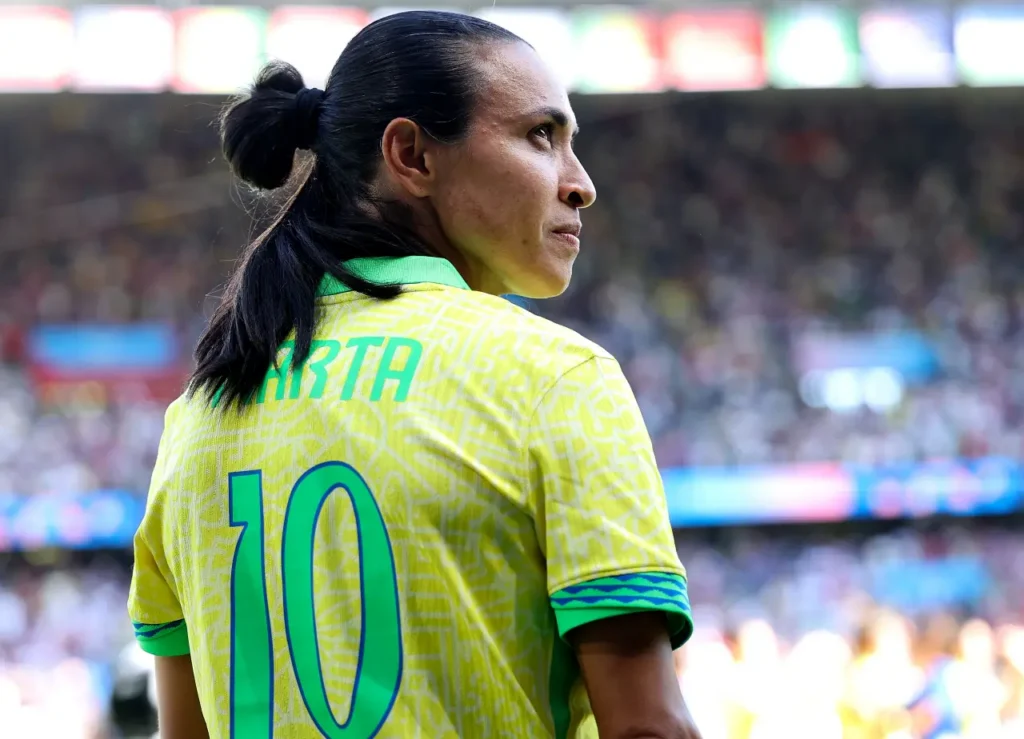
A media storm has erupted in Brazil after the broadcast of a women’s friendly football match between Brazil and Italy (1–0) was suddenly cut off midway through the second half. The reason given was the airing of an “urgent” live report on a police operation against the Comando Vermelho gang in Rio de Janeiro. Although the TV network justified its decision as a matter of “news priority,” public reactions left no doubt that for many Brazilians, it was yet another humiliation for women’s football.
A Match That Was Pushed Aside
The Brazil–Italy match, played as part of preparations for next year’s tournaments, was meant to be another step in popularizing women’s football in a country where the sport is almost a religion. On the pitch shone Marta, the legendary player regarded as one of the greatest female footballers in history. Fans expected a spectacle that would once again prove that Brazilian women’s football has enormous potential and deserves the same respect as the men’s game.
Instead, viewers suddenly saw the broadcast switch; the match was interrupted, and the station began airing footage of a police operation in one of Rio’s favelas. While this may have seemed like a simple editorial decision at first glance, it quickly became a flashpoint in the debate over women’s role in sports and the way the media treats women’s competitions.
“Police More Important Than Marta?” – Media and Public Reactions
Brazilian journalist Joaquin Teixeira was among the first to bring attention to the issue, posting on platform X (formerly Twitter) and quoting a comment from an internet user:
“MACHISMO: Radical far-right extremists celebrate the interruption of women’s football because of the operation against Comando Vermelho. ‘Rio’s police deserve more than Marta,’ says one reader.”
The original Portuguese quote read:
“MACHISMO: Extremistas de ultra direita radical comemoram a interrupção do futebol feminino por causa da operação contra o Comando Vermelho. ‘A polícia do Rio merece ganhar mais que a Marta’, diz leitor.”
Though the comment was likely ironic, it captured the mood among women’s football fans. Many social media users expressed outrage that the broadcast was cut off just as the match was gaining momentum, only to show a police action that could easily have been reported later.
The Broader Context: Inequality in Sports Broadcasting
This incident is not isolated. In South America, as in many other parts of the world, women’s sports, despite their rapid growth, are still treated as secondary. Data from Brazil’s media market shows that women’s football broadcasts make up only a tiny fraction of total sports airtime.
Many commentators point out that the interruption of the Brazil–Italy match is not just an unfortunate coincidence, but a symptom of a deeper problem: the lack of equality in how men’s and women’s sports are treated.
According to analysis by WomenLiveScore, Brazilian TV stations frequently interrupt or reschedule women’s matches for news segments, commercials, or other programs, even when the topics are not urgent. In men’s matches, such situations almost never occur.
Public Outrage and Expert Reactions
Sports sociologist Dr. Lúcia Ferreira from the University of São Paulo told local media that the decision to cut off the broadcast was symbolic:
“This isn’t just about one match. It shows how women are still pushed to the margins of public space, even when they succeed. Marta is an icon of Brazilian football, yet the media found a police operation more important. It’s a painful reminder that equality in sports is still far away.”
Former Brazil national team player Formiga shared a similar view, posting on social media:
“When men play, the whole country watches. When women play, even the broadcast can disappear. How can we inspire young girls if their sport continues to be dismissed?”
Economics and Data: Viewership Drop After the Broadcast Cut
According to preliminary data from media analysts, the decision to interrupt the broadcast also had economic consequences. Within minutes of the program change, the network’s viewership dropped by more than 30%, showing that audiences did not accept the editorial choice.
Experts suggest the incident may push Brazilian broadcasters to rethink their programming policies. Some politicians, including congresswoman Maria do Rosário, have already announced plans to submit a parliamentary inquiry on ensuring equal treatment of women’s sports in public media.
Conclusion: More Than Just an Interrupted Match
The interruption of the Brazil–Italy broadcast is more than a media incident; it’s a social mirror reflecting gender inequality in sports and culture. Although the Rio police were indeed conducting an important operation against organized crime that day, the choice between covering that and continuing a women’s match became, for many, a symbol of value hierarchy: security and sensationalism above women’s sporting passion.
For women’s football fans, it’s a bitter moment but also a chance for reflection. As women’s football continues to grow in global popularity, Brazil, the country that gave the world Pelé, Ronaldinho, and Marta, must now ask itself: does it truly treat men’s and women’s football with equal seriousness?