
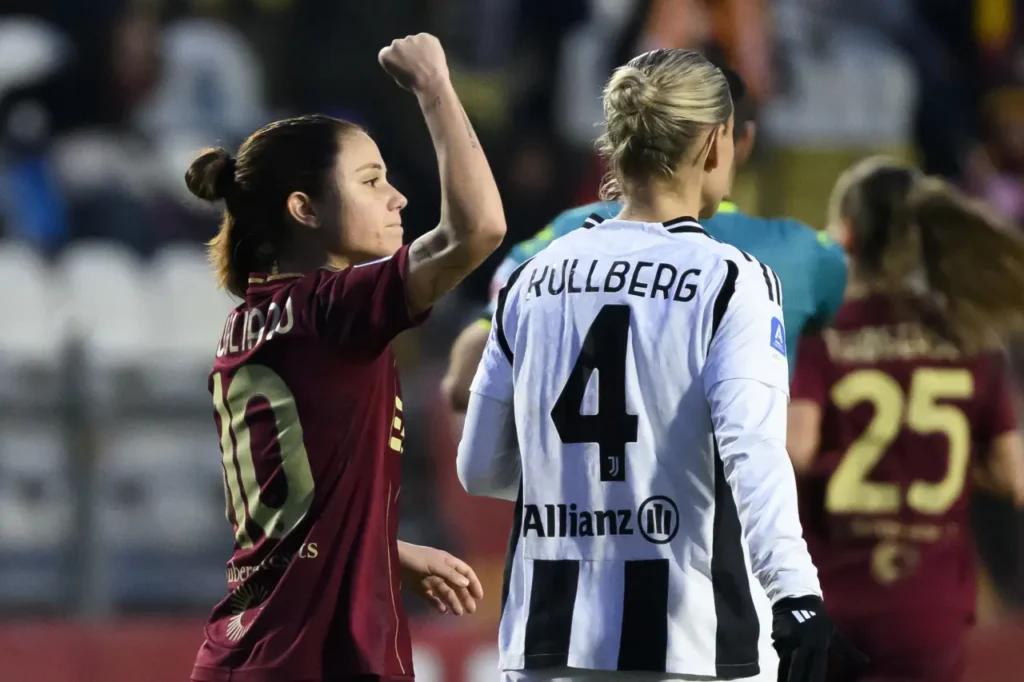
The Strength Lies in the Diversity of Playing Styles
In discussions about women’s football, comparisons with the men’s game appear constantly.
People talk about pace, physical strength, and spectacle. It is not uncommon to hear statements suggesting that women’s football is “weaker,” “slower,” or therefore “less attractive.”
Such comments are based on a false assumption that men’s football represents the standard every other form should strive for.
In reality, women’s football has its own identity, its own rhythm, and its own playing culture.
It is not worse, nor better. It is simply different.
Physiological Differences and Playing Style
Biological differences between male and female players are a fact.
Men, statistically, have greater maximum strength and speed.
Women, on the other hand, often excel in areas such as motor coordination, movement flexibility, and technical precision in tight spaces.
These are not “deficiencies,” but different athletic profiles that naturally translate into a different way of constructing plays and conducting the game.
In women’s football, we often see longer passing sequences, more effective use of space, and a greater emphasis on collective attacking.
Because individual strength differences are smaller, one-on-one duels matter less than the cooperation of entire formations.
This makes the game more tactical, with quicker decision-making under pressure.
Less Physicality, More Fluidity
Where men’s matches can be brutal, hard-fought, and frequently interrupted by fouls, women’s football is often characterized by a smoother flow of play.
Less physical aggression does not mean less intensity, quite the opposite.
Players often maintain a consistent tempo throughout the match, without long breaks for fouls or stoppages.
For many fans, this results in a clearer, more readable form of football, where it is easier to notice tactical patterns, automatisms, positional rotations, and pressing structures.
Coaches who analyze women’s football often emphasize that women’s matches require a different kind of tactical interpretation, more systemic than individual.
Diversity of Styles Enriches the Sport
The sports world has long benefited from diversity.
Women’s tennis is not “worse” than men’s, it is played differently.
Women’s volleyball highlights different strengths than men’s volleyball, yet it remains equally exciting.
The same applies to football.
Women’s football does not need to copy the men’s model to be valuable.
On the contrary, its unique character is a key element of its growth.
This very difference attracts new audiences to the game:
- new fans,
- families with children,
- people who previously were not interested in football,
- and sponsors seeking new markets and authentic engagement.
Media and Cultural Expectations
The main issue lies in how the story is told.
For decades, the media have promoted men’s football as the “proper” model of sporting emotion, while the women’s game was often treated as a curiosity, “something extra.”
That narrative still shapes how many people judge both versions of the sport.
When we stop viewing women’s football through a lens of comparison, we begin to see its true value:
- as a space for developing athletic talent,
- as a culture of teamwork and collaboration,
- and as a growing media product that is expanding faster than most other sports.
Changing the narrative is key.
Appreciation, Not Imitation
The goal should not be to “catch up” with men’s football or to replicate it.
The goal is to build women’s football on its own foundations: technical quality, team dynamics, fluidity of play, and tactical clarity.
When we accept that diversity in playing styles is a strength, not a weakness, women’s football will no longer be seen as an “alternative,” but as a fully integrated part of the football ecosystem.