
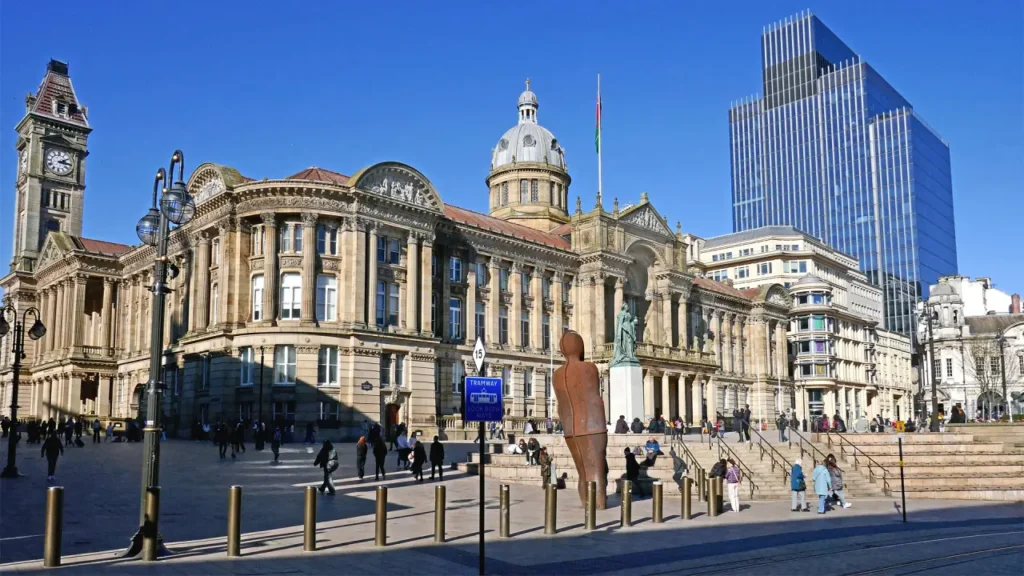
When Birmingham announced that it intends to bid for the title of host city of the 2035 FIFA Women’s World Cup, many considered it an ambitious, even bold move. The city, which in recent years has struggled with financial and social problems, now wants to stand alongside the metropolises that have already hosted the world’s biggest sporting events. But Birmingham’s candidacy is not just a sporting project; it is a statement of vision, and at the same time, a signal of a serious debate about inclusion, infrastructure, and the identity of modern England.
Ambition, British Style
The British have long had an ambivalent relationship with women’s football. Although England has achieved international success, the women’s game still fights for full social acceptance and financial equality. In this context, the idea that Birmingham, the country’s second-largest city, could host the Women’s World Cup sounds like a symbolic gesture of breaking barriers.
As local authorities explain, the goal of the bid is not only to promote the city but also “to show that equality in sport is a real value, not just a marketing slogan.” Hosting the tournament would also boost the local economy, attract investment, and revive neglected parts of the metropolis.
Infrastructure at a Crossroads
However, this enthusiasm immediately clashed with reality. Birmingham, although it has several stadiums that meet FIFA requirements such as Villa Park or St. Andrew’s Stadium, still faces shortcomings in its transport and hotel infrastructure. Critics point out that the city, which in 2023 effectively declared municipal bankruptcy, should not be reaching for an event of this scale.
A spokesperson for the city council, however, argues that “hosting the World Cup can serve as a modernization impulse,” similar to how the London 2012 Olympics revitalized the capital. Yet, as commentators note, London had a far more stable financial and logistical base. In Birmingham, every major investment will have to be justified down to the last pound, and any missteps could burden residents with debt for decades.
Inclusion: A Popular Word, but Is It Real?
What has sparked the most emotion, however, is not infrastructure but the topic of inclusion and diversity. After the bid announcement, online comments began questioning whether Birmingham is truly an open city. One tweet that gained significant attention asked ironically whether “everyone will be welcome by then,” a biting provocation in the context of social tensions in the UK.
This shows that a sporting bid is no longer free from politics. The city, which prides itself on multiculturalism, must now face the question of how real inclusion looks in practice: whether all residents feel safe, represented, and accepted. The Women’s World Cup could become a catalyst for positive change, but it could just as easily expose fractures in the city’s social fabric.
Women’s Football as a Catalyst for Change
We cannot forget the heart of the matter, the growing phenomenon of women’s football. Recent editions of the World Cup have drawn record audiences and proved that women’s football is not a niche but a rapidly growing segment of the sports market. The tournaments in Australia and New Zealand (2023) and the one planned for Brazil in 2027 show that FIFA is taking this branch of the sport increasingly seriously.
For Birmingham, then, this would not only be a prestigious opportunity but also a chance to create a lasting legacy, both in infrastructure and mentality. If the city manages to use the World Cup to develop youth clubs, promote girls’ sports education, and build local communities around football, the effects could be felt for generations.
Between Idealism and Pragmatism
Is Birmingham ready for such a step? That question divides both experts and residents. Supporters emphasize that “if not now, when?” Women’s sport is on the rise, and the UK needs a symbol showing it can be a leader in the fight for gender equality. Opponents, however, warn that grand ideals must not overshadow real financial and social limits.
It is the classic British dilemma: how to combine the dream of modernity with the distrust of overreaching ambition. Birmingham could become an example of how sport drives development and integration, or a warning that good intentions are not enough without a coherent strategy and fiscal discipline.
The World Cup as a Test of the Future
Ultimately, this bid is more than just a sporting project; it is a test of the city’s future. Can Birmingham turn its ethnic and cultural diversity into an advantage? Can it convince FIFA and the public that the Women’s World Cup is not a whim but a logical step toward modernity?
As the history of major sporting events shows, success does not depend solely on stadiums and ticket sales. The most important question is: is the community ready to believe in this project? Because only then can women’s football in Birmingham become more than a temporary promotional slogan; it can become a symbol of change that truly unites.